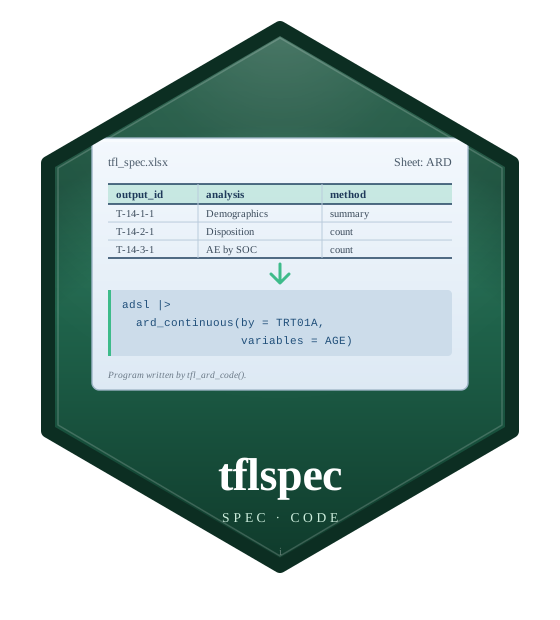
The ARD spec is the study’s analyses as a workbook.
tfl_ard_code() writes the R program it stands for – cards /
cardx calls, one per analysis row – and tfl_build_ard()
runs that program and saves one study ARD (analysis
results data) that every table then reads.
The program is meant to be read. A dataset is read in one line, an
analysis set is one subset(), an analysis data is one pipe,
an analysis is one call. It is written the way a programmer would write
it, so that it can be reviewed, copied into a study and finished by hand
when needed.
library(tflspec)

study <- file.path(tempdir(), "ard-study")
dir.create(file.path(study, "data"), recursive = TRUE, showWarnings = FALSE)
saveRDS(adsl, file.path(study, "data", "adsl.rds"))   # the sample study's ADaM
saveRDS(adae, file.path(study, "data", "adae.rds"))

df <- function(...) data.frame(..., stringsAsFactors = FALSE)
The sheets
| Sheet | One row per | Holds |
|---|---|---|
study |
key |
id (the subject key), output (where the
ARD goes), source (R files of the study’s own
functions) |
datasets |
dataset |
dataset, level, path
(relative to the study folder), derive (columns made on
reading) |
populations |
analysis set |
population_id, dataset,
where, derive
|
analysis_data |
named data of a report |
output_id, data_id, label,
from, population_id, subjects,
where, add, derive,
keep, distinct, code
|
analyses |
analysis |
output_id, analysis_id,
method, data or dataset +
population_id, where, by,
strata, variables, statistics,
denominator, formats, args,
code, parent, post, … |
Every column is described on its header cell’s comment in the
workbook, and by tfl_spec_columns():
cols <- tfl_spec_columns("analysis_data")
knitr::kable(cols[!is.na(cols$column), c("column", "description")])| column | description | |
|---|---|---|
| 2 | data_id | The data’s name, and its object’s name in the ARD
program: a lower-case letter first, then letters, digits, _ or . – not a
dataset’s, pop_ |
| 3 | label | A name a person reads; blank: none. |
| 4 | from | What it is made from: a dataset, or an analysis data of a row above. |
| 5 | population_id | Keeps the subjects of this population; blank: no restriction here (made from an analysis data: that one’s population). |
| 6 | subjects | Keeps the subjects of an analysis data above (a report’s own subjects: the safety set in phase 1 …): the numerator kept to the denominator’s subjects. Instead of population_id; blank: no restriction here. |
| 7 | where | An R condition on the records (the numerator’s filter); blank: every record. |
| 8 | add | Columns of the population’s data (its dataset, ADSL) –
or of the data of subjects – added by the subject key, |
between them; a column of the same name is replaced. Needs a population
or subjects, here or above; blank: none. |
| 9 | derive | New columns, NAME = R expression, | between them (transform()); a column the code lists list becomes a factor in their order; blank: none. |
| 10 | keep | The columns kept, | between them (the subject key always); with derive, what transmute() does; blank: every column. |
| 11 | distinct | One row for each set of values of these columns, | between them (dplyr::distinct(), the first row kept): a denominator per subject and phase; blank: every row. |
| 12 | code | R that makes the data itself, when the columns cannot
say it: its value is the data; the datasets (adae), pop_ |
A new workbook starts from tfl_ard_spec_template(); it
is read with tfl_read_ard_spec() and written with
tfl_write_ard_spec(). The examples below build the sheets
in R with tfl_ard_spec(), which checks them exactly as the
reader does.
Datasets and populations
base <- list(
  study = df(key = c("id", "output"),
             value = c("USUBJID", "output/ard/ard.rds")),
  datasets = df(dataset = c("ADSL", "ADAE"),
                path = c("data/adsl.rds", "data/adae.rds")),
  populations = df(population_id = "SAF", dataset = "ADSL",
                   where = 'SAFFL == "Y"'))
A population is an analysis set: the subjects of dataset
for which where holds. In the program it is
pop_<population_id>. An analysis row may name a
dataset and a population_id: its data are then
that dataset’s records of the analysis set’s subjects.
spec <- tfl_ard_spec(c(base, list(analyses = df(
  output_id = "T-14-1-1", analysis_id = "AGE", method = "continuous",
  population_id = "SAF", by = "TRT01A", variables = "AGE"))))
cat(tfl_ard_code(spec, part = "body"), sep = "\n")
report_id <- "T-14-1-1"

# ---- data ----
adsl <- readRDS("data/adsl.rds")

# ---- populations ----
pop_saf <- filter(adsl, SAFFL == "Y")

# ---- analyses ----
# AGE
ard_age <- pop_saf |>
  ard_summary(
    by = TRT01A,
    variables = AGE,
    fmt_fun = everything() ~ fmt_default
  ) |>
  apply_fmt_fun() |>
  tag_ard(report_id, "AGE", population = "SAF")

# the report's rows of the study ARD, with the fingerprint of its
# definition (tfl_ard_spec_hash())
ard_age |>
  save_ard(report_id, definition = "3a67c8569ba5a342d3c3f784a15c74a1")
Analysis data
When several analyses read the same data – treatment-emergent events
of the safety set, say – the sheet analysis_data names it
once.
An analysis data is a report’s:
output_id says whose, and it is required. A row’s
from and subjects name only its own report’s
rows above it, and an analysis reads only its own report’s data. So the
same data_id may mean something else in another report –
the safety set of a Phase I table and of a Phase II one – and a data two
reports use is copied into each (tflplanner’s “copy from another
report”).
Each row makes one data, in this order:
-
froma dataset or an analysis data above it; - kept to the subjects of a population (
population_id) or of an analysis data above (subjects: the numerator kept to the denominator’s subjects); - the records
wherekeeps; - columns of the population’s data added by the subject key
(
add); - columns derived (
derive), and the columns kept (keep; withderive, atransmute()); - one row per set of values (
distinct).
data_id is the object’s name in the program. An analysis
names it in its data column instead of dataset
/ population_id.
adata <- df(
  output_id = "T-14-3-1",
  data_id = c("adsl_saf", "adae_teae", "adae_ser"),
  label = c("Safety set", "TEAEs of the safety set", "Serious TEAEs"),
  from = c("ADSL", "ADAE", "adae_teae"),
  population_id = c("SAF", NA, NA),
  subjects = c(NA, "adsl_saf", NA),
  where = c(NA, 'TRTEMFL == "Y"', 'AESER == "Y"'),
  keep = c(NA, "AEBODSYS | AEDECOD | AESER | TRT01A", NA))

analyses <- df(
  output_id = "T-14-3-1",
  analysis_id = c("TEAE", "SER"),
  method = "hierarchical",
  data = c("adae_teae", "adae_ser"),
  by = "TRT01A",
  variables = c("AEBODSYS | AEDECOD", "AEDECOD"),
  denominator = "adsl_saf")

spec <- tfl_ard_spec(c(base, list(analysis_data = adata, analyses = analyses)))
cat(tfl_ard_code(spec, part = "body"), sep = "\n")
report_id <- "T-14-3-1"

# ---- data ----
adsl <- readRDS("data/adsl.rds")
adae <- readRDS("data/adae.rds")

# ---- analysis data ----
# adsl_saf: Safety set
adsl_saf <- filter(adsl, SAFFL == "Y")
# adae_teae: TEAEs of the safety set
adae_teae <- adae |>
  filter(USUBJID %in% adsl_saf$USUBJID, TRTEMFL == "Y") |>
  select(USUBJID, AEBODSYS, AEDECOD, AESER, TRT01A)
# adae_ser: Serious TEAEs
adae_ser <- filter(adae_teae, AESER == "Y")

# ---- analyses ----
# TEAE
ard_teae <- adae_teae |>
  ard_hierarchical_or_none(
    by = TRT01A,
    variables = c(AEBODSYS, AEDECOD),
    denominator = adsl_saf,
    id = USUBJID
  ) |>
  fmt_ard(fmt_default) |>
  tag_ard(report_id, "TEAE", population = "SAF")

# SER
ard_ser <- adae_ser |>
  ard_hierarchical_or_none(
    by = TRT01A,
    variables = AEDECOD,
    denominator = adsl_saf,
    id = USUBJID
  ) |>
  fmt_ard(fmt_default) |>
  tag_ard(report_id, "SER", population = "SAF")

# the report's rows of the study ARD, with the fingerprint of its
# definition (tfl_ard_spec_hash())
bind_rows(ard_teae, ard_ser) |>
  save_ard(report_id, definition = "cebab636000d2d2289c3e1238e45aec9")
What the columns cannot say: code
When the columns cannot say how a data is made, code is
R whose value is the data. The datasets, the pop_* analysis
sets and the analysis data above it are in reach. from
stays (it says what the data is made from), and the other columns that
make a data are left blank (this is checked):
adata2 <- adata[1:2, ]
adata2$output_id <- "T-14-3-2"     # its own copy of the two data
adata2 <- rbind(adata2, df(
  output_id = "T-14-3-2",
  data_id = "adae_first", label = "First TEAE of each subject and term",
  from = "adae_teae", population_id = NA, subjects = NA, where = NA,
  keep = NA))
adata2$code <- c(NA, NA, paste(
  "adae_teae <- adae_teae[order(adae_teae$USUBJID, adae_teae$AEDECOD), ]",
  "adae_teae[!duplicated(adae_teae[c(\"USUBJID\", \"AEDECOD\")]), ]",
  sep = "\n"))
spec2 <- tfl_ard_spec(c(base, list(
  analysis_data = adata2,
  analyses = df(output_id = "T-14-3-2", analysis_id = "FIRST",
                method = "categorical", data = "adae_first",
                by = "TRT01A", variables = "AEDECOD"))))
cat(tfl_ard_code(spec2, part = "body"), sep = "\n")
report_id <- "T-14-3-2"

# ---- data ----
adsl <- readRDS("data/adsl.rds")
adae <- readRDS("data/adae.rds")

# ---- analysis data ----
# adsl_saf: Safety set
adsl_saf <- filter(adsl, SAFFL == "Y")
# adae_teae: TEAEs of the safety set
adae_teae <- adae |>
  filter(USUBJID %in% adsl_saf$USUBJID, TRTEMFL == "Y") |>
  select(USUBJID, AEBODSYS, AEDECOD, AESER, TRT01A)
# adae_first: First TEAE of each subject and term
adae_first <- local({
  adae_teae <- adae_teae[order(adae_teae$USUBJID, adae_teae$AEDECOD), ]
  adae_teae[!duplicated(adae_teae[c("USUBJID", "AEDECOD")]), ]
})

# ---- analyses ----
# FIRST
ard_first <- adae_first |>
  ard_tabulate(
    by = TRT01A,
    variables = AEDECOD,
    fmt_fun = everything() ~ fmt_default
  ) |>
  apply_fmt_fun() |>
  tag_ard(report_id, "FIRST", population = "SAF")

# the report's rows of the study ARD, with the fingerprint of its
# definition (tfl_ard_spec_hash())
ard_first |>
  save_ard(report_id, definition = "5a928109371010b18d526b388d9cdf56")
The program carries it as
<data_id> <- local({ ... }), in the sheet’s order.
The spec keeps the code: the program is written from the spec and is
never edited afterwards.
Analyses
One row is one cards / cardx call. Both ids become ARD columns, so a
table takes its rows with tfl_ard_for(ard, output_id).
-
method: a keyword –tfl_ard_methods()lists them, each with a label a person reads – or anypkg::functionof cards / cardx, or a function of the study’s own (study keysource).
knitr::kable(tfl_ard_methods()[, c("method", "label", "call")])| method | label | call |
|---|---|---|
| continuous | Summary statistics | cards::ard_summary |
| categorical | Counts and percents | cards::ard_tabulate |
| dichotomous | Count of one level | cards::ard_tabulate_value |
| missing | Missing counts | cards::ard_missing |
| hierarchical | Nested counts (e.g. SOC / PT) | cards::ard_stack_hierarchical |
| max | Worst level per subject | cardx::ard_tabulate_max |
| subjects | Subjects with a record | (subjects) |
| total_n | Number of subjects | cards::ard_total_n |
| proportion_ci | Proportion with CI | cardx::ard_categorical_ci |
| mean_ci | Mean with CI | cardx::ard_continuous_ci |
| ttest | t test | cardx::ard_stats_t_test |
| wilcox | Wilcoxon rank-sum test | cardx::ard_stats_wilcox_test |
| chisq | Chi-square test | cardx::ard_stats_chisq_test |
| fisher | Fisher’s exact test | cardx::ard_stats_fisher_test |
| custom | Custom R code | (code) |
-
by,strata,variables,statistics:|between several values.stratarepeats the analysis within each combination present in the data (a parameter by visit). -
denominator: what percentages are of –population,row,column,cell, another population, a dataset or an analysis data. -
formats:mean=xx.x | p=xx.x%(thexxpart says the decimals). -
args: more arguments, as R (over_variables = TRUE). A function that takes a formula gets it here:formula = survival::Surv(AVAL, 1 - CNSR) ~ TRT01P. -
parentandpost: rows run insidecards::ard_stack()/ard_strata()/ard_pairwise(), and steps on the ARD after the call (cards::sort_ard_hierarchical()).
tfl_ard_functions() lists every installed cards / cardx
ard_*() function by category, and
tfl_ard_args() says in which column each argument of one
goes:
a <- tfl_ard_args("cardx::ard_categorical_ci")
knitr::kable(a[, c("arg", "column", "choices")])| arg | column | choices |
|---|---|---|
| data | data | |
| variables | variables | |
| by | by | |
| method | args | waldcc | wald | clopper-pearson | wilson | wilsoncc | strat_wilson | strat_wilsoncc | agresti-coull | jeffreys |
| denominator | denominator | column | row | cell |
| conf.level | args | |
| value | args | |
| strata | strata | |
| weights | args | |
| max.iterations | args |
An analysis written as R: custom
What no column can say is written as R in code, with
method custom. In the code data
is the analysis data and population the analysis set’s
subjects. tfl_ard_as_custom() writes an existing row as
that code (the same ARD), as a starting point:
cat(tfl_ard_as_custom(spec, "T-14-3-1", "SER")$code, sep = "\n")
cards::ard_stack_hierarchical(
  data,
  by = TRT01A,
  variables = AEDECOD,
  denominator = adsl_saf,
  id = USUBJID
)
Code lists
A table spec’s codelists sheet (one row a value:
output_id, variable, value,
label, order) gives the order of a variable’s
values and what each value is in the data the report’s program makes
(label; blank: the value itself). A code list is a
report’s: every row names its report, and a blank
output_id is an error (a code list two reports use is
copied into each; the same arm may print one way in one table and
another way in the next).
Handed to the ARD program, a report’s code lists of the variables its
analyses read (by, strata,
variables, and the names in args,
code and post) are written at the program’s
head (cl_sex <- c(F = "Female", M = "Male")) and put on
those columns before any analysis
(set_levels(SEX = cl_sex)): each becomes a factor in the
list’s order with the labels as its values, so the ARD holds
“Female”, keeps the order and counts a value no record
has (n = 0). A value the list does not have stops
the program, naming the column and the value; a condition on such a
column is written in its labels (SEX == "Female"). A
variable the table only prints is not made a factor. A data made from
another – an analysis set, an analysis data, an analysis’s own subset –
is made factors again as its last step (|> .levels()): a
value the list does not have counts only where the data analysed have it
(a table of the safety set has no column for the screen failures’
arm).
codelists <- df(output_id = "T-14-1-1", variable = "SEX", value = c("M", "F"),
                label = c("Male", "Female"), order = 1:2)
spec3 <- tfl_ard_spec(c(base, list(analyses = df(
  output_id = "T-14-1-1", analysis_id = "SEX", method = "categorical",
  population_id = "SAF", by = "TRT01A", variables = "SEX"))))
cat(tfl_ard_code(spec3, part = "body", codelists = codelists), sep = "\n")
report_id <- "T-14-1-1"

# ---- code lists: each value in its order, as it is in the ARD ----
# (a value a list does not have stops the program: add it to the list)
cl_sex <- c(M = "Male", F = "Female")

# ---- data ----
adsl <- readRDS("data/adsl.rds")

# ---- populations ----
pop_saf <- adsl |>
  filter(SAFFL == "Y") |>
  set_levels(SEX = cl_sex)

# ---- analyses ----
# SEX
ard_sex <- pop_saf |>
  ard_tabulate(
    by = TRT01A,
    variables = SEX,
    fmt_fun = everything() ~ fmt_default
  ) |>
  apply_fmt_fun() |>
  tag_ard(report_id, "SEX", population = "SAF")

# the report's rows of the study ARD, with the fingerprint of its
# definition (tfl_ard_spec_hash())
ard_sex |>
  save_ard(report_id, definition = "551d1e645d45f180865cffeac5fce902")
set_levels() and the other functions the program calls
are not tflspec’s exports: tfl_helpers_code() gives their
code, which a study keeps in a file of its own (tflplanner:
programs/study_helpers.R), so the programs run without
tflspec. A variable’s heading in a table is the variables
sheet’s label; see The table
spec.
Building the ARD
tfl_build_ard() runs the program from the study folder.
The ARD carries output_id, analysis_id and
population_id; tfl_ard_conditions() lists what
went wrong while it was made (cards carries on when one analysis fails,
leaving the message in the ARD).
ard <- tfl_build_ard(spec, dir = study, save = FALSE)
table(ard$analysis_id)
#>
#>  SER TEAE
#>  126  264
tfl_ard_conditions(ard)
#> [1] output_id   analysis_id variable    groups      level       message
#> [7] statistics
#> <0 rows> (or 0-length row.names)
tfl_check_ard(ard, spec) checks an ARD made elsewhere
(its shape, and what the tables read from it);
tfl_write_ard() writes a copy as JSON, YAML or XPT.
tfl_ard_spec_hash() is the fingerprint of an output’s
definition, saved with the ARD so a screen can tell which outputs are
out of date.
The whole program
tfl_ard_code(spec) is the whole file: the packages and
helpers, the data, the analyses, saveRDS(). Write it to the
study’s programs/ and run it there; tflspec is not needed
to run it.
tfl_ard_code(spec, output_id = ) is one report’s
program, the form a study runs (tflplanner writes one per report). The
study’s program, with every report, is one part a report after the
datasets and analysis sets: each part makes its own analysis data before
its analyses, and, when a report has code lists, reads its data again
with them – so one report’s analysis data and factors are never the next
report’s.
writeLines(tfl_ard_code(spec), file.path(study, "programs", "ard.R"))